Complex Disordered Systems

Gelation

Francesco Turci

Today

  • Physical gels and percolation
  • Colloid-polymer mixtures
  • Structure and characterization
  • Arrested spinodal decomposition

What is a Physical Gel?

Physical gel: Particles/polymers connected via reversible, non-covalent bonds forming a percolating network

Key features:

  • Bonds break/reform dynamically
  • Energy ~ k_BT
  • Self-healing possible
  • Thermoreversible

Examples:

  • Gelatin
  • Agarose
  • Yoghurt
  • Paint, inks

Cross-links form via dense local regions (microcrystalline/glassy)

Physical vs Chemical Gels

Physical Gels

  • Reversible bonds
  • Energy ~ k_BT
  • Dynamic network
  • Thermoreversible

Chemical Gels

  • Irreversible covalent bonds
  • High energy barriers
  • Permanent network

Key transition:

  • Fluid → Gel occurs when a system-spanning cluster forms (percolation)
  • Dramatic viscosity increase + elastic response

Gels are a second example of disordered solids (after glasses)

Percolation Theory

Problem: Square grid L\times L sites, randomly label N of them. When does a spanning cluster form?

  • p = N/L^2 = occupation probability
  • Percolation threshold p_c
  • Below p_c: small clusters
  • Above p_c: giant spanning cluster

2D square lattice: p_c \approx 0.5927

Transition: Continuous (2nd order)

Percolation Simulation

Percolation Transition

Percolation Threshold: p_c Values

Non-universal: p_c depends on lattice type and dimension

Lattice Dim z p_c^{site} p_c^{bond}
Square 2 4 0.593 0.5
Triangular 2 6 0.5 0.347
Cubic 3 6 0.312 0.249
Hypercubic 4 8 0.197 0.160
Hypercubic 6 12 0.109 0.094

Higher dimensions → lower p_c (easier to percolate)

Critical Exponents: Universal

Universal: Critical exponents independent of lattice details

P_{\infty}(p)\propto (p-p_c)^{\beta}

Dimension d \beta
2 5/36 ≈ 0.14
3 ≈ 0.41
≥6 1 (mean-field)

Gels require percolation for mechanical stability!

Colloidal Gel Formation

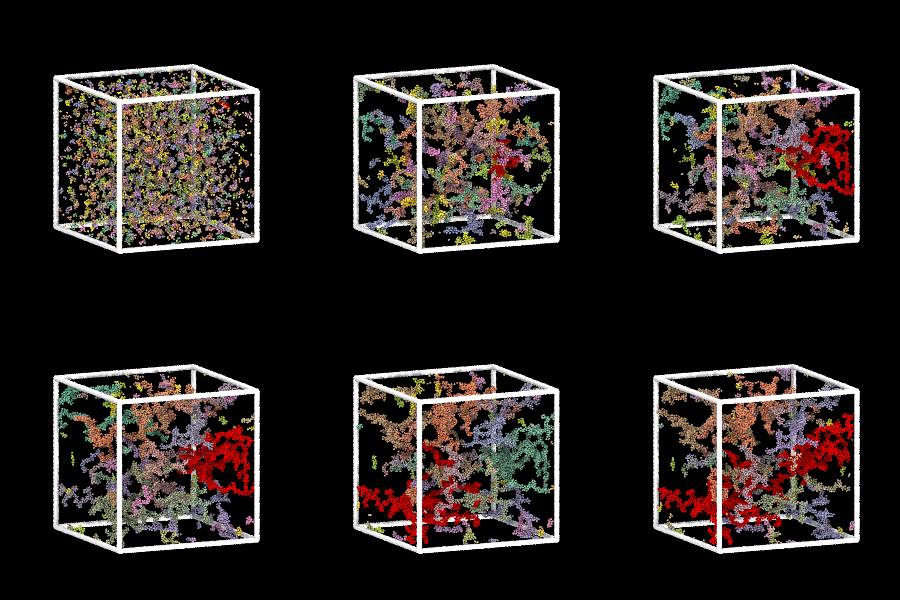
MD simulation of dilute colloidal gel formation (largest cluster in red)

Percolating cluster → mechanical rigidity

Colloid-Polymer Mixtures

Depletion interactions like the Asakura-Oosawa model produce a very short ranged potential with strong attractive part. W_{\mathrm{AO}}(r)=-\frac{4 \pi \rho_p k_B T}{3} R^3(1+q)^3\left[1-\frac{3}{4} \frac{r}{R(1+q)}+\frac{1}{16}\left(\frac{r}{R(1+q)}\right)^3\right], \quad 2R<r<2(R+R_p), \quad q=\dfrac{R_p}{R}

attractive + very short ranged → sticky interaction

  • Colloids cluster into nonequilibrium branched phase
  • Binodal becomes metastable to fluid-solid coexistence

Phase diagram of colloid-polymer mixtures for varying polymer-colloid aspect ration q. Small

Simple Model Potentials

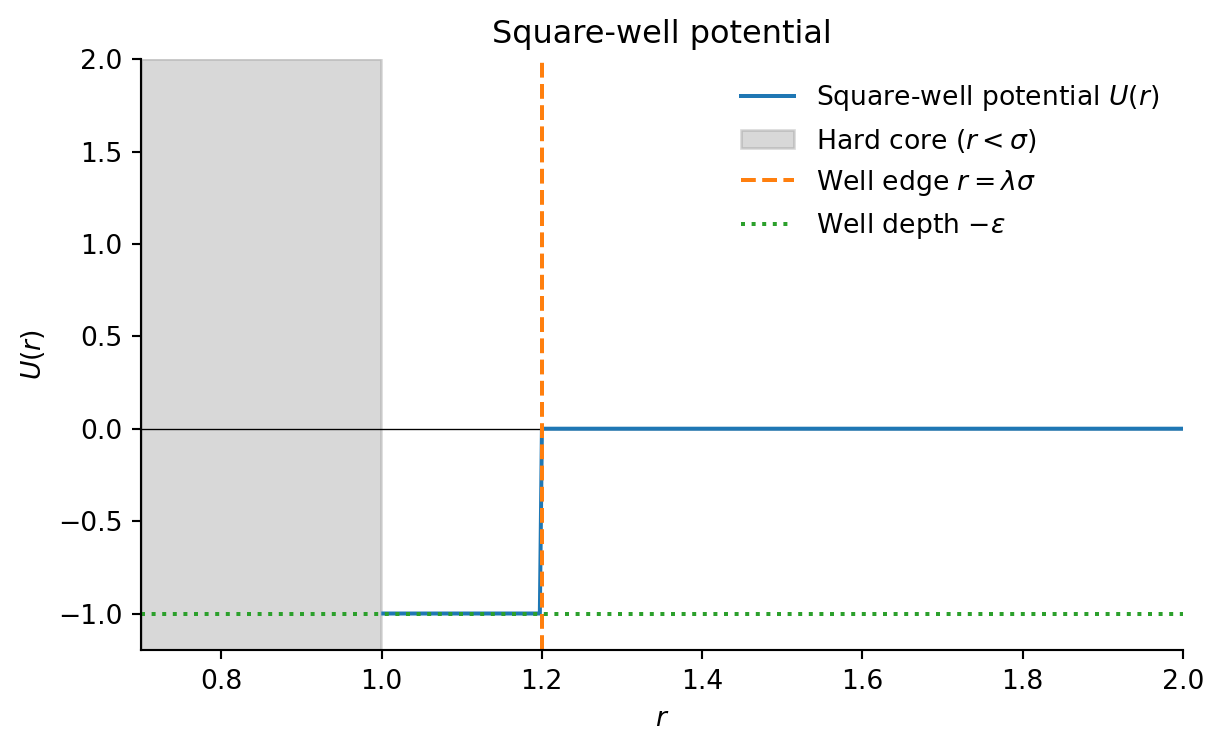
Square-well potential:

U(r) = \begin{cases} \infty & r < \sigma \\ -\epsilon & \sigma \leq r < \lambda \sigma \\ 0 & r \geq \lambda \sigma \end{cases}

  • \sigma: particle diameter
  • \epsilon: well depth
  • \lambda: range parameter

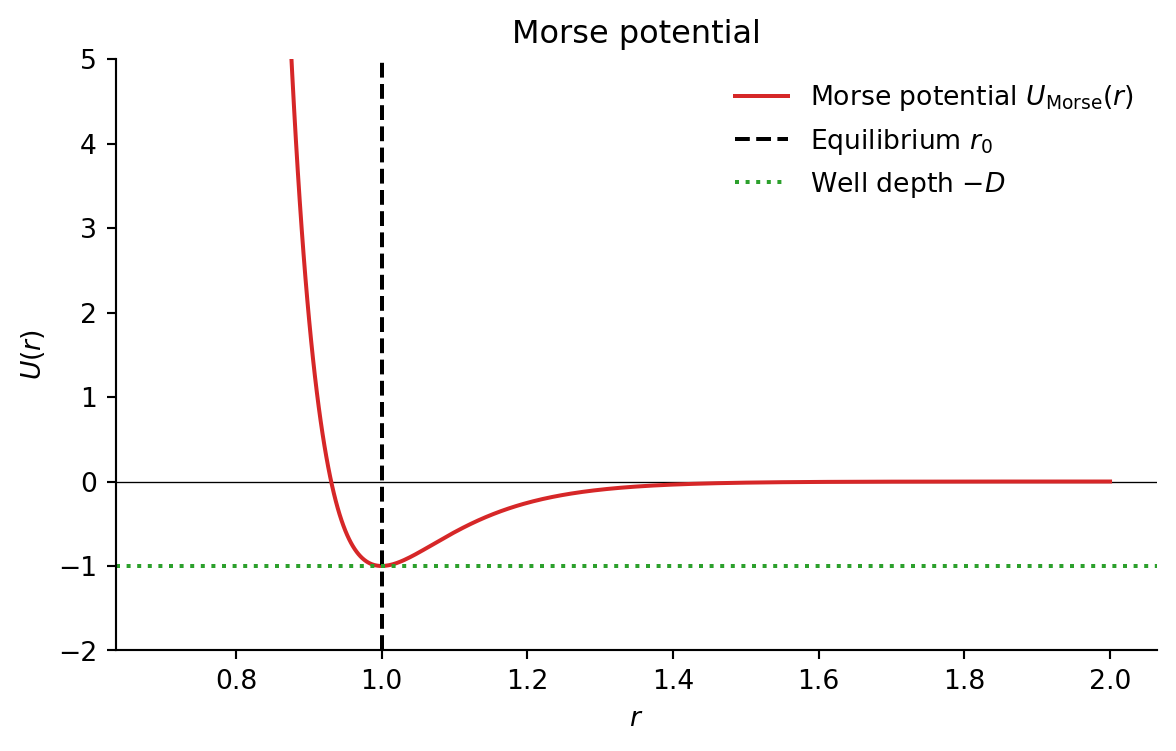
Morse Potential (MD Simulations)

Smooth short-range attractive potential:

U_{\mathrm{Morse}}(r) = D \left[ e^{-2\alpha (r - r_0)} - 2 e^{-\alpha (r - r_0)} \right]

  • D: well depth
  • \alpha: steepness (controls range)
  • r_0: equilibrium distance

Pair Correlations: g(r)

Radial distribution function g(r): best at short distances

  • Captures cluster structure
  • Sharp peaks at dilute concentrations
  • Nearest/second-nearest neighbor shells
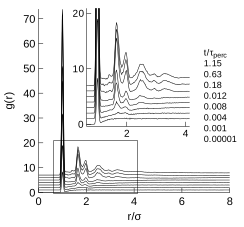
Time evolution of g(r) ina dilute gel in units of the time to percolate \tau_{\mathrm perc}

Structure Factor: S(q) and Fractals

Near percolation threshold, the loq-q trend from the trsucture factor links to the compressibility: power-law behavior:

Clusters become fractal objects with self-similar structure at all length scales.

For a fractal object with dimension D_f:

  • Mass scales as M(R) \sim R^{D_f}
  • Density correlations decay as \rho(r) \sim r^{-(d-D_f)}

Fourier transform of power-law correlations gives: S(q) \sim q^{-D_f}

  • D_f: fractal dimension
  • No characteristic length scale
  • Typical 3D: D_f \approx 2.5

Time evolution of the structure factor S(q)

Arrested Spinodal Decomposition

How do gels form?

Scenario:

  1. Rapid quench into unstable region
  2. Phase separation begins (spinodal)
  3. Dense regions arrest (glass/jamming)
  4. Bicontinuous frozen structure

The picture suggest the progressive freezing of coarsening upon spinodal decomposition.

Phase Diagram: Arrested Spinodal

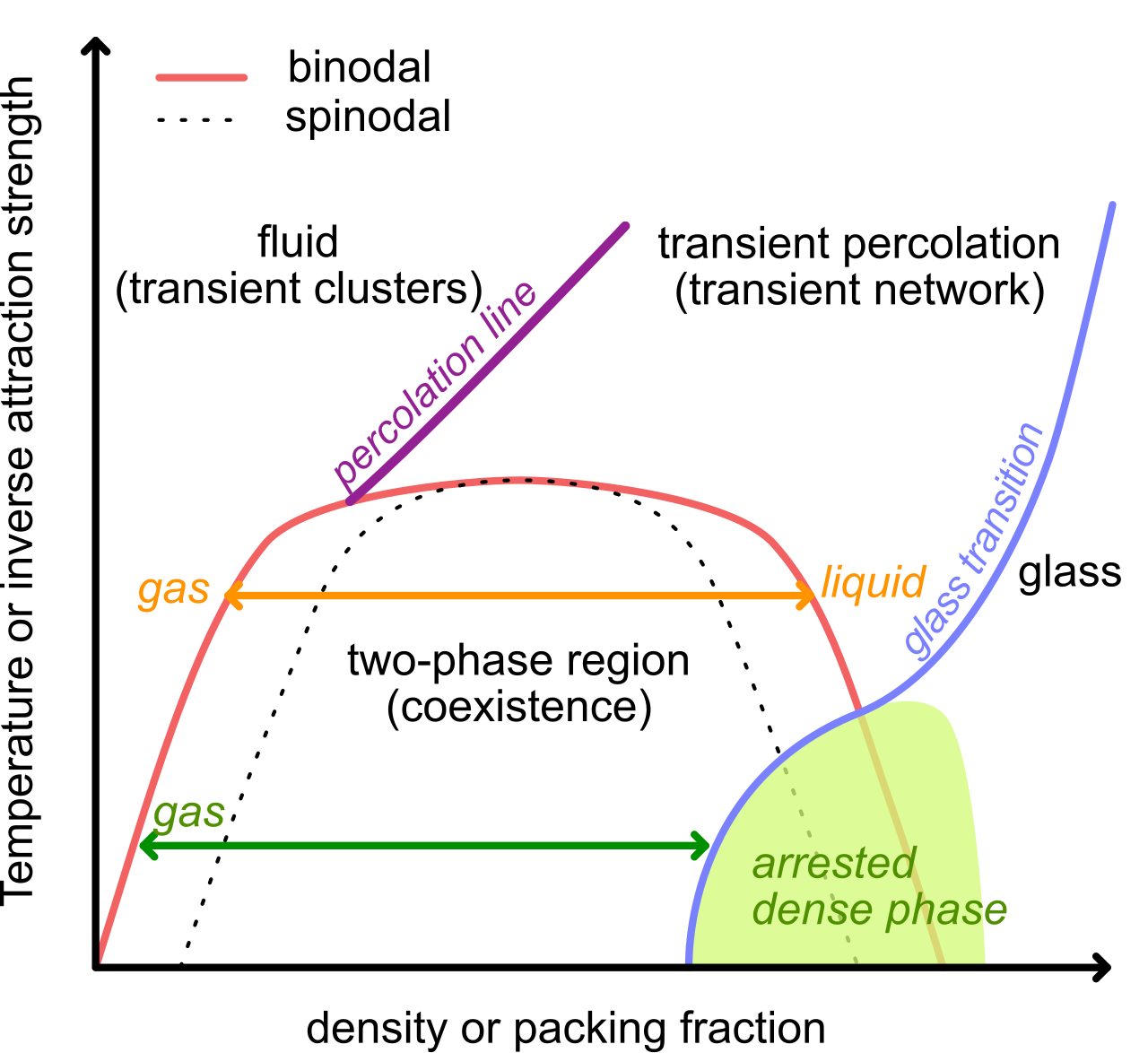
Arrested spinodal scenario, see Zaccarelli et al 2007

Key lines:: - Binodal (red): liqiid-gase coexistence at equilibrium - Spinodal (dashed): limit of stability of the metastable phases. Instability (i.e. spinodal decomposition) starts inside - Percolation (purple): At some density, the clusters percolate (span the system) - Glass transition (blue): Dense phase becomes dynamically arrested (non-ergodic)

Gel path: Rapid cooling → arrested dense phase + vapor