viewof params = Inputs.form({
    T: Inputs.range([0., 4], {label: "Temp.", value: 1.0, step: 0.1,}),
    g: Inputs.range([-2, 2], {label: "Tilt", value: 0, step: 0.1}),
    reset: Inputs.button("Reset simulation")
})

// Simulation parameters
dt = 0.005
kB = 1
gamma = 1

// Double well potential: V(x) = x^4 - 2x^2 + g*x
V = (x, g) => x**4 - 2*x**2 + g*x
force = (x, g) => -(4*x**3 - 4*x + g)

// Live simulation with temperature control
simulationState = {
    let x = 0
    let positions = [0]
    let step = 0

    while (true) {
        if (params.reset) {
            x = 0
            positions = [0]
            step = 0
        }

        let f = force(x, params.g)
        let noise = Math.sqrt(2 * kB * params.T * dt / gamma) * (Math.random() - 0.5) * 2
        x += (f / gamma) * dt + noise
        positions.push(x)
        // Keep only last 500 points for performance
        if (positions.length > 500) {
            positions = positions.slice(-500)
        }

        yield {x, positions: [...positions], step: step++}
        await new Promise(resolve => setTimeout(resolve, 10))
    }
}

// Plot
Plot.plot({
    width: 700,
    height: 400,
    grid: true,
    x: {domain: [-2.5, 2.5], label: "Position"},
    y: {domain: [-2, 3], label: "Potential Energy"},
    marks: [
        // Potential curve
        Plot.line(
            Array.from({length: 200}, (_, i) => {
                let x = -2.5 + 5 * i / 199
                return {x, y: V(x, params.g)}
            }),
            {x: "x", y: "y", stroke: "red", strokeWidth: 2}
        ),
        // Particle trajectory (trail)
        Plot.line(
            simulationState.positions.map((x, i) => ({x, y: V(x, params.g), step: i})),
            {x: "x", y: "y", stroke: "blue", strokeWidth: 1, opacity: 0.5}
        ),
        // Current particle position
        Plot.dot([{
            x: simulationState.x,
            y: V(simulationState.x, params.g)
        }], {x: "x", y: "y", fill: "blue", r: 6, stroke: "white", strokeWidth: 2})
    ]
})Complex Disordered Systems
Entropy matters

More is different
Philip Anderson (Science 1972)
Complexity emerges when many simple units interact: studying the individual components does not explain the emergence of collective properties
Simple examples:
- phases of matter
- magnetism, superconductivity
- emergence of order from disorder
Also beyond physics:
- formation of biological molecules
- ecological networks
- economic structures (markets, currencies etc.)

Beyond the usual phases of matter
We sometimes oversimplify…
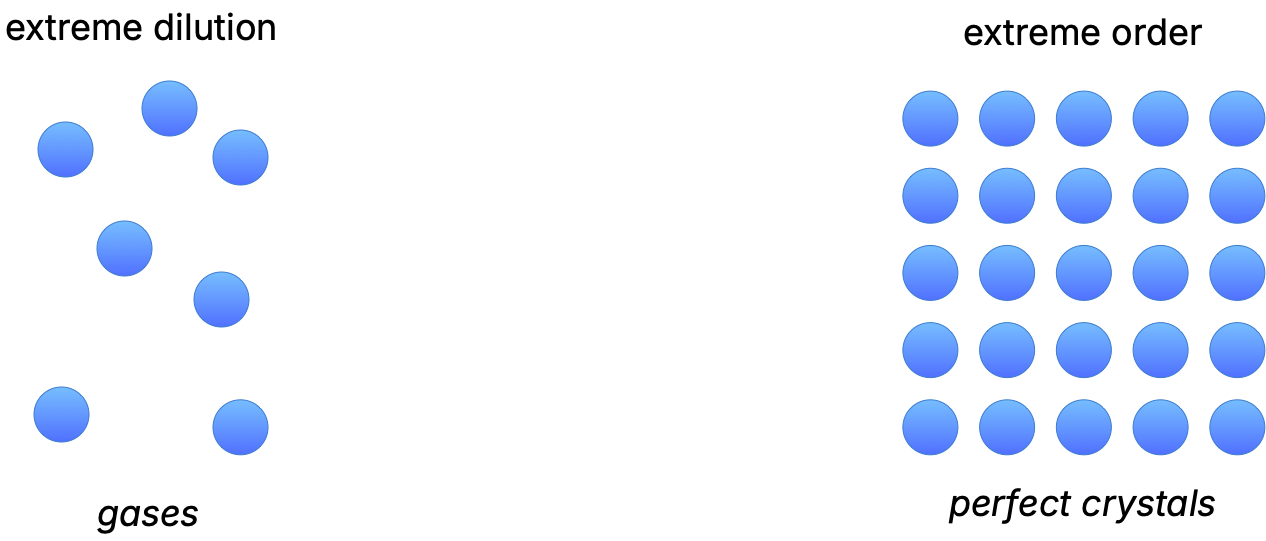
Extreme examples of phases of matter
Beyond the usual phases of matter
We sometimes oversimplify… 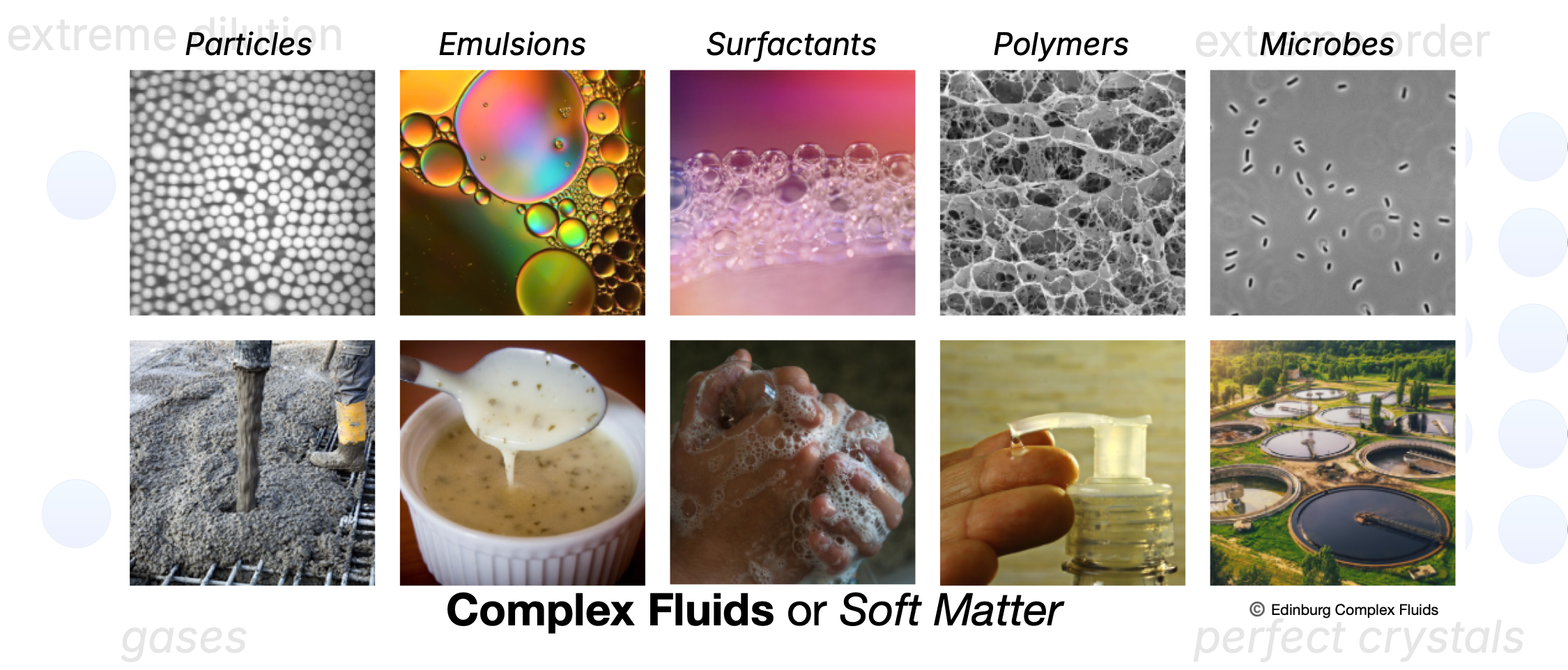
Coarse graining
- Soft matter interactions are mainly electrostatic.
- Atomistic details are often unimportant for macroscopic properties.
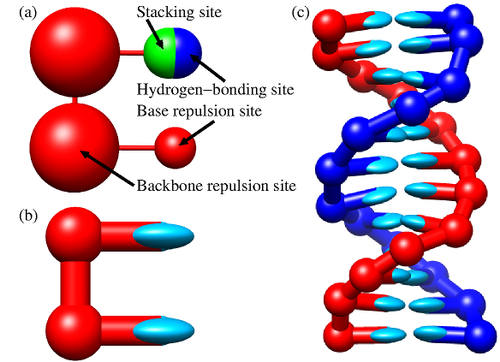
- Coarse-graining simplifies models by focusing on key features:
- deliberate selection of what matters
- systematic integration of a number of degrees of freedom
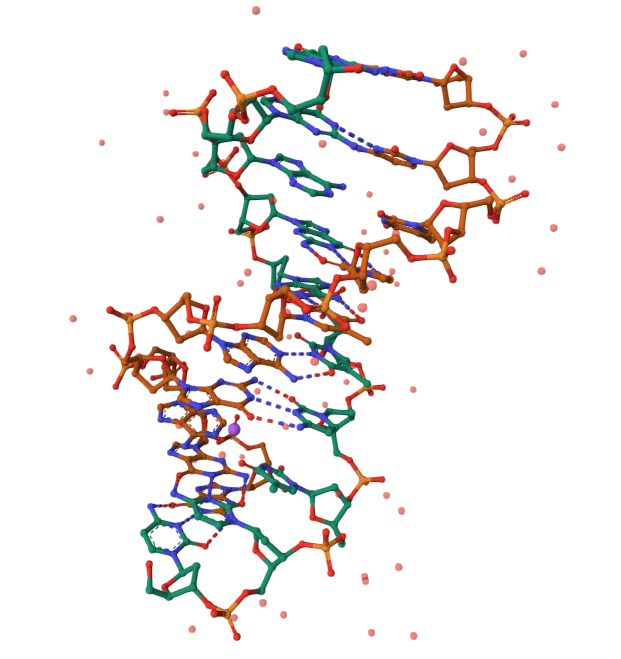
- Example: The oxDNA model represents DNA as a chain of coarse grained units, much larger than the atoms.
Coarse graining
- Soft matter interactions are mainly electrostatic.
- Atomistic details are often unimportant for macroscopic properties.
- Coarse-graining simplifies models by focusing on key features:
- deliberate selection of what matters
- systematic integration of a number of degrees of freedom
- Example: The oxDNA model represents DNA as a chain of coarse grained units, much larger than the atoms.
Classes of systems
In our exploration of soft matter we will focus on six main classes of systems which display different physics:
- colloidal dispersions
- polymeric systems
- liquid crystals
- surfactant aggregates
- arrested systems
- active matter

Colloidal dispersions
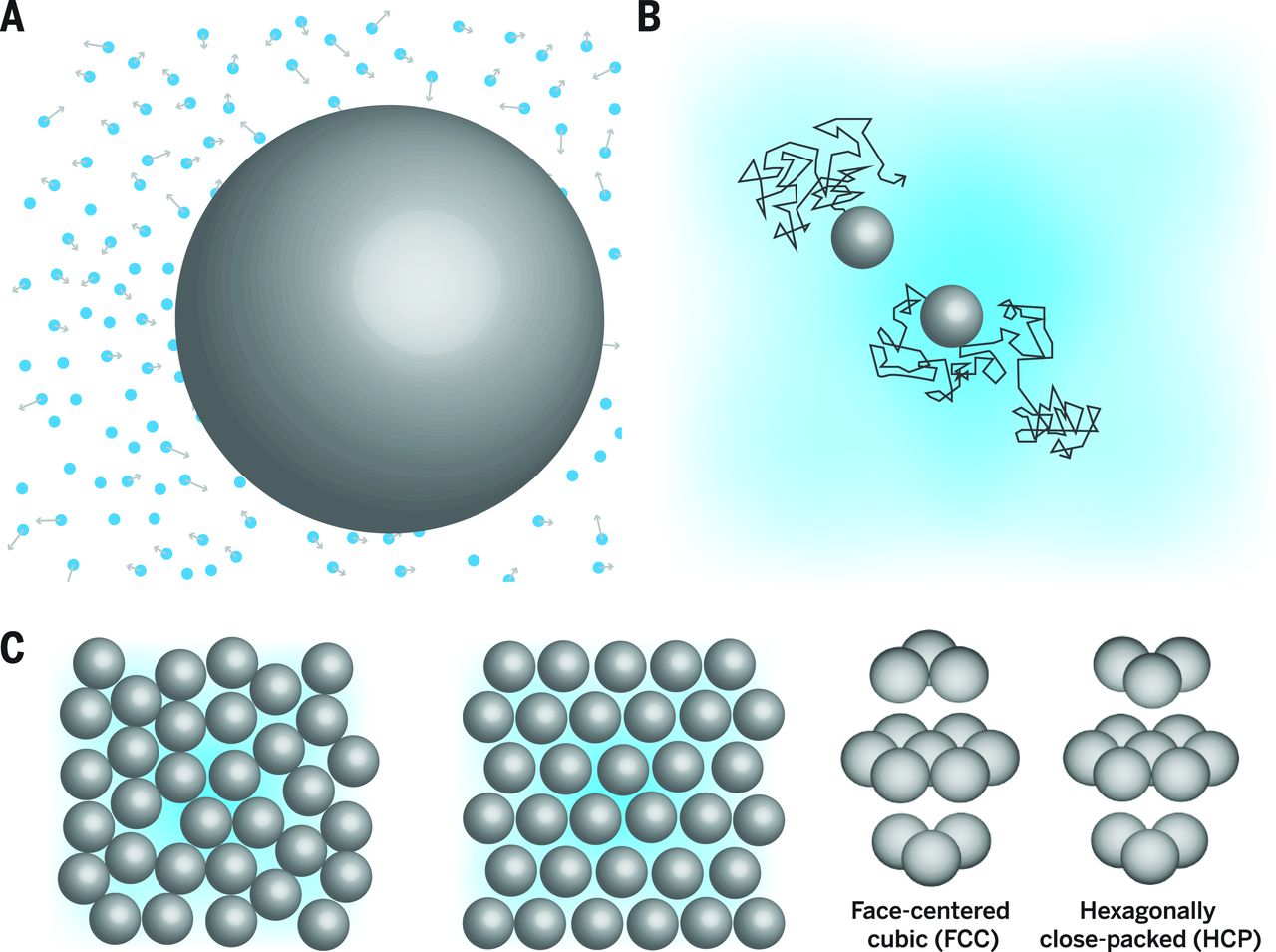
Colloidal dispersions: small particles (nano–micrometer) suspended in a solvent.
Spherical colloids are common, but many shapes and interactions exist.
Behave as “big atoms”: show Brownian motion, phase transitions, and can form ordered structures.
Larger size and slower dynamics make them ideal for direct observation of phenomena like:
- crystallisation
- glass formation
- gel formation
Polymeric systems
- Polymers are long-chain macromolecules made of repeating monomers.
- Their properties result from a balance of entropy and energy.
- Two main types: synthetic polymers (e.g., plastics) and biopolymers (e.g., DNA, proteins).
- Entanglement: chains cannot cross, leading to unique mechanical behavior.
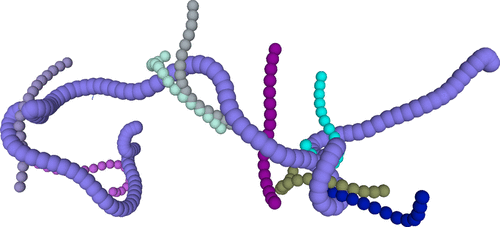
Polymer entanglement, from Likhtman and Ponmurugan, Macromolecules (2014)
Liquid crystals
Liquid crystals form when anisotropic soft matter units (e.g., rod-like or disk-shaped molecules) pack densely, leading to partial order—intermediate between liquids and crystals.
Continuum free energy theories describe liquid crystals by considering the symmetry of their order parameters.
Liquid crystals are crucial in technologies like liquid crystal displays (LCDs).
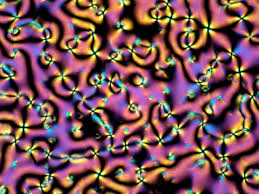
Texture of nematic liquid crystals, from https://doi.org/10.3986/alternator.2020.38
Surfactant aggregates
- Surfactants lower surface tension between fluid phases by accumulating at interfaces.
- They are molecules with both hydrophilic heads and hydrophobic tails.
- Surfactants self-assemble at interfaces, forming structures like bilayers and vesicles.
- These assemblies are essential in cell biology and many soft matter systems.
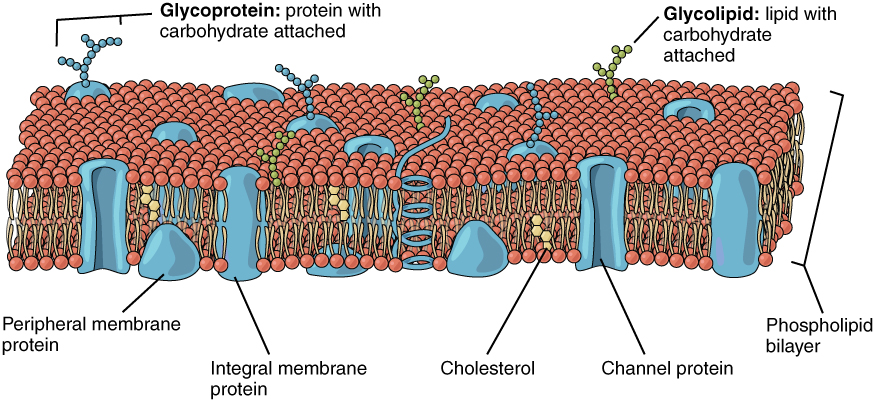
Cellular membrane
Arrested systems
- Arrested systems are trapped in disordered, non-equilibrium states.
- Lack of long-range order leads to slow structural relaxation and prevents reaching the global energy minimum.
- Examples: glasses and gels
- These systems exhibit rigidity, elasticity, and plasticity: disordered (semi)-solids.
- Relaxation times are longer than observable timescales, making equilibrium statistical mechanics insufficient.
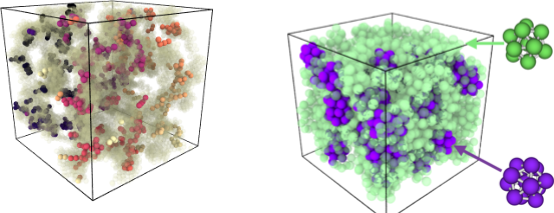
An gel (left) and a glass (right) from molecular dynamics with local structure highlighted un colours
Active matter
- Active matter: systems of units that consume energy to move or exert forces.
- Inherently out of equilibrium due to continuous energy input.
- Includes biological systems (bacteria, cells, flocks) and synthetic systems (self-propelled colloids).
- Shows emergent collective behaviors: swarming, clustering, pattern formation.
- Studied using hydrodynamic theories and agent-based models.

Example of active systems, from Cichos et al. Nature Machine Intelligence (2020)
Kinds of colloids
- Colloids = dispersed phase + dispersion medium

Destabilisation
Milk is an emulsion where droplets of fat are dispersed in water and stabilised by proteins.
If lemon juice is added, the dispersion medium (water) changes, the pH drops, and the emulsion is destabilised.
The interactions change → separation of curds (solid) and whey (liquid).
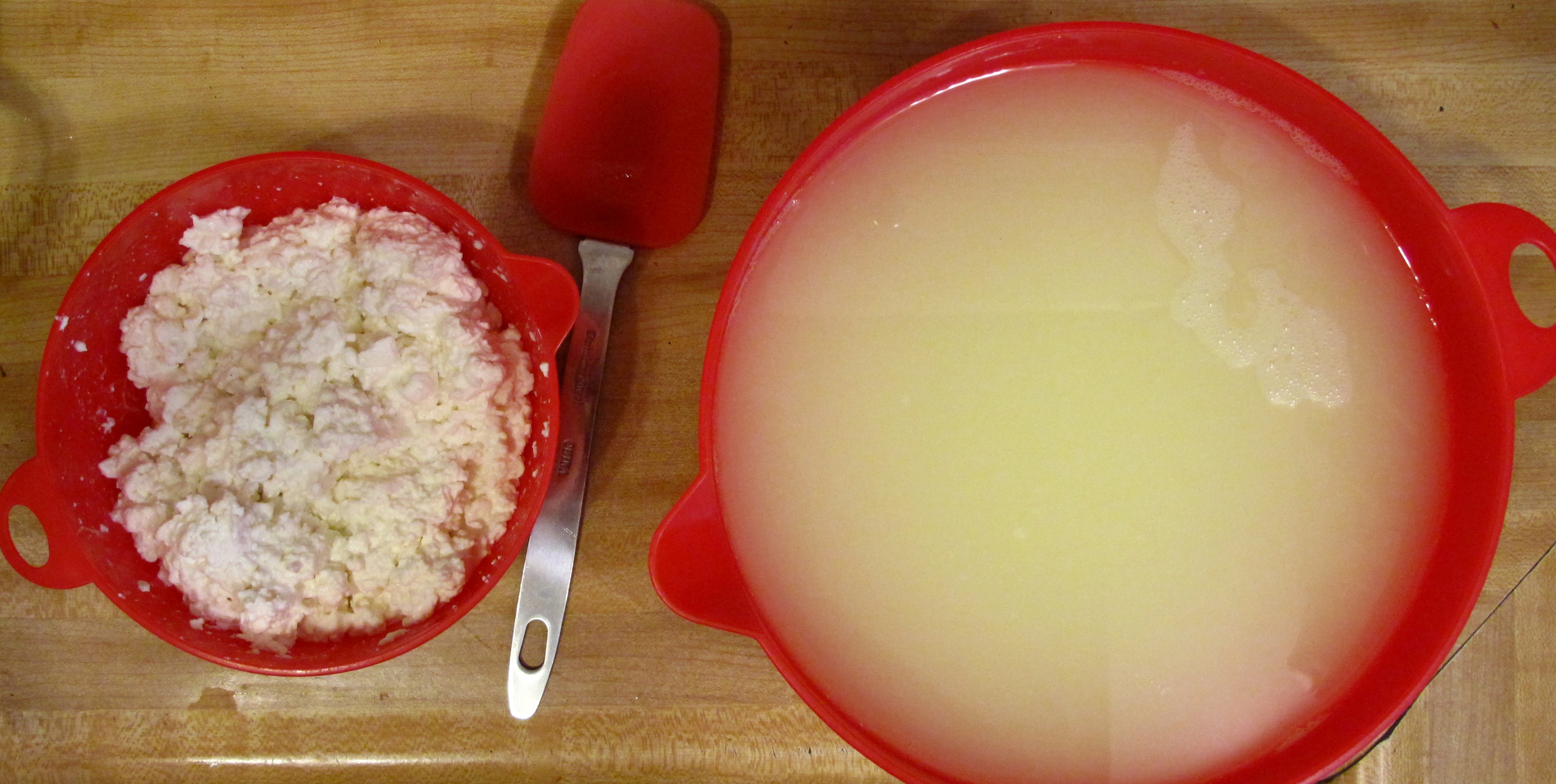
Curds and whey resulting from the destabilisation of milk, a colloidal emulsion. (Wikimedia)