4The Ising model: the prototype model for a phase transition
In order to probe the properties of the critical region, it is common to appeal to simplified model systems whose behaviour parallels that of real materials. The sophistication of any particular model depends on the properties of the system it is supposed to represent. The simplest model to exhibit critical phenomena is the two-dimensional Ising model of a ferromagnet. Actual physical realizations of 2-d magnetic systems do exist in the form of layered ferromagnets such as K\(_2\)CoF\(_4\), so the 2-d Ising model is of more than just technical relevance.
4.1 The 2D Ising model
The 2-d spin-\(\frac{1}{2}\) Ising model envisages a regular arrangement of magnetic moments or ‘spins’ on an infinite plane. Each spin can take two values, \(+1\) (‘up’ spins) or \(-1\) (‘down’ spins) and is assumed to interact with its nearest neighbours according to the Hamiltonian
where \(J>0\) measures the strength of the coupling between spins and the sum extends over nearest neighbour spins \(s_i\) and \(s_j\), i.e it is a sum of the bonds of the lattice. \(H\) is a magnetic field term which can be positive or negative (although for the time being we will set it equal to zero). The order parameter is simply the average magnetisation:
\[m=\frac{1}{N} \langle \sum_i s_i \rangle\:,\] where \(\langle\cdot\rangle\) means an average over typical configurations corresponding to the prescribed value of \(J/k_BT\).
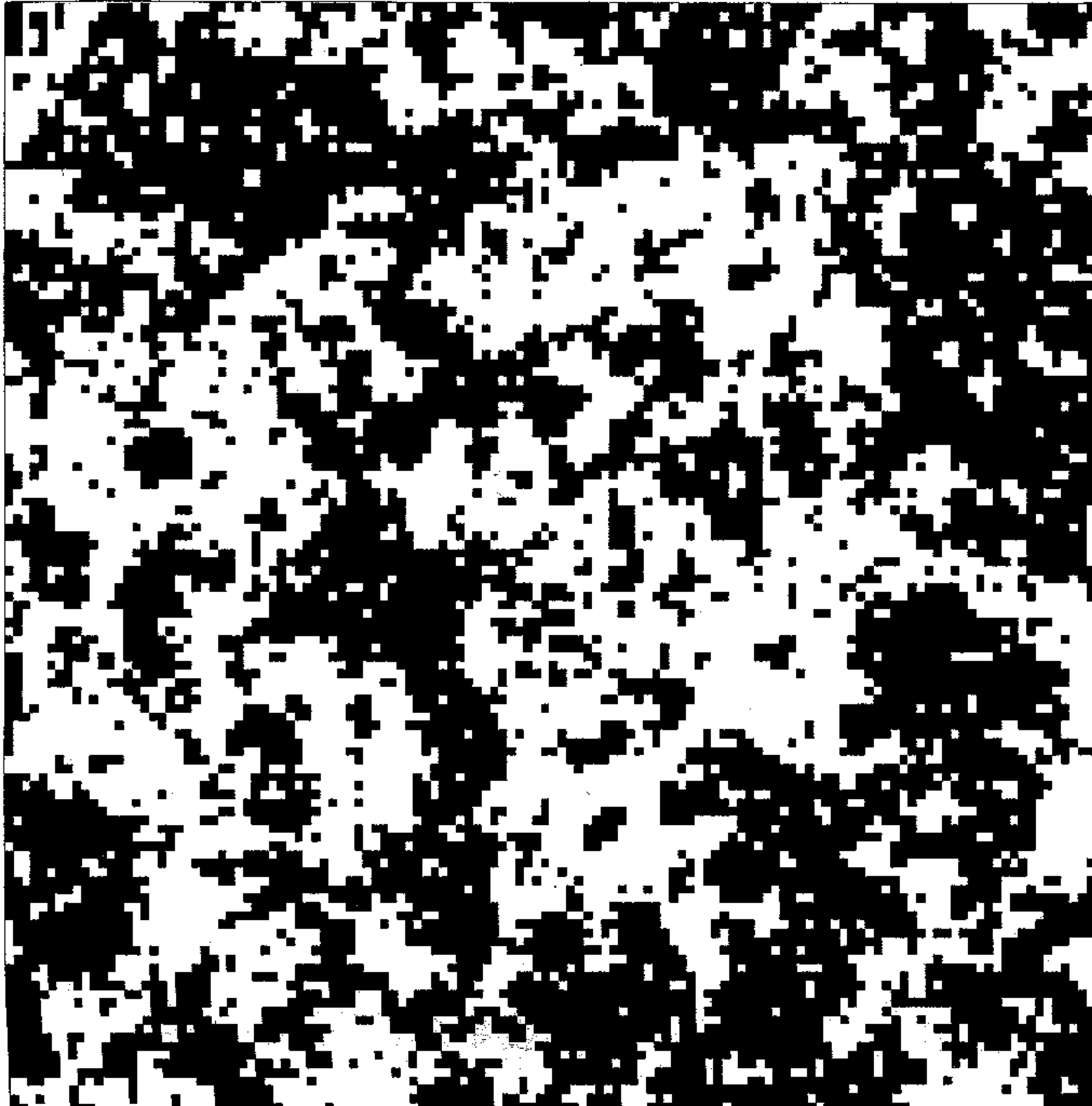
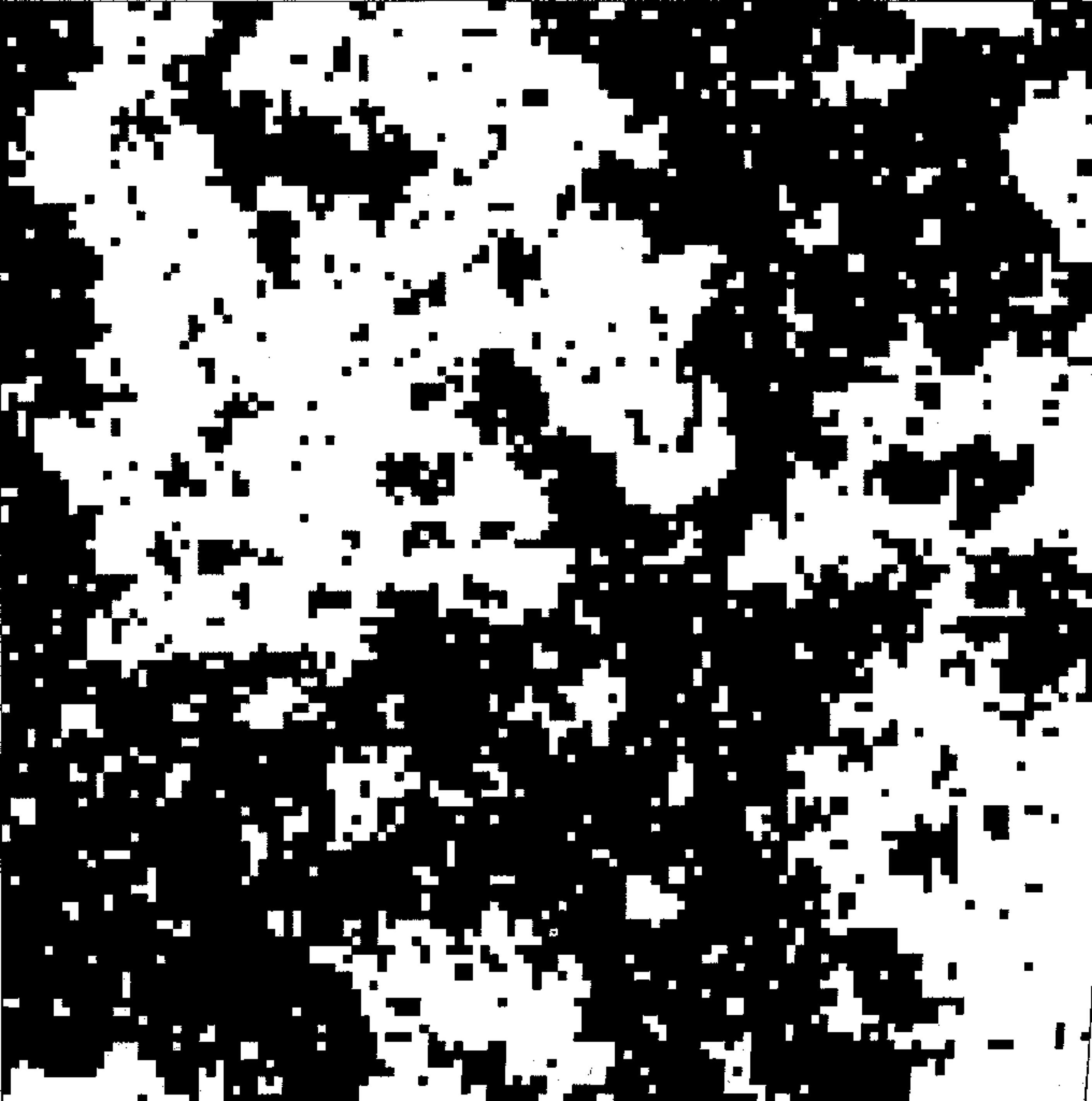
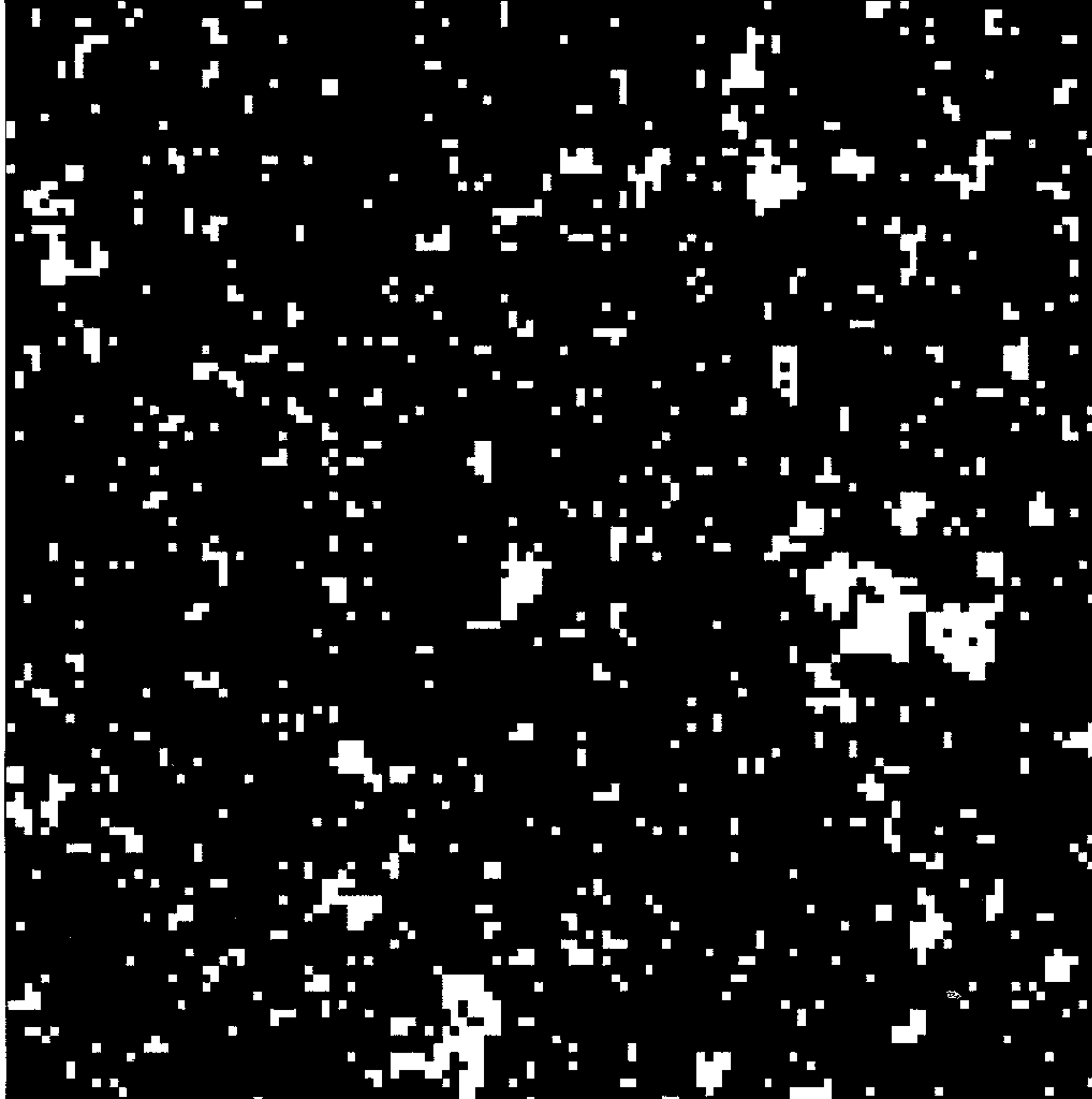
The fact that the Ising model displays a phase transition was argued in Chapter 2. Thus at low temperatures for which there is little thermal disorder, there is a preponderance of aligned spins and hence a net spontaneous magnetic moment (ie. the system is ferromagnetic). As the temperature is raised, thermal disorder increases until at a certain temperature \(T_c\), entropy drives the system through a continuous phase transition to a disordered spin arrangement with zero net magnetisation (ie. the system is paramagnetic). These trends are visible in configurational snapshots from computer simulations of the 2D Ising model (see Figure 4.1). Although each spin interacts only with its nearest neighbours, the phase transition occurs due to cooperative effects among a large number of spins.
(a) \(T=1.2T_c\)
(b) \(T=T_c\)
(c) \(T=0.95T_c\)
Figure 4.1: Configurations of the 2d Ising model. The patterns depict typical arrangements of the spins (white=+1, black=−1) generated in a computer simulation of the Ising model on a square lattice of \(N=512\) sites, at temperatures (from left to right) of \(T= 1.2T_c\), \(T=T_c\), and \(T=0.95T_c\). In each case only a portion of the system containing \(128\) sites in shown. The typical island size is a measure of the correlation length \(\xi\): the excess of black over white (below \(T_c\) is a measure of the order parameter.
An interactive Monte Carlo simulation of the Ising model demonstrates the phenomenology, By altering the temperature you will be able to observe for yourself how the typical spin arrangements change as one traverses the critical region. Pay particular attention to the configurations near the critical point. They have very interesting properties. We will return to them later!
Although the 2-d Ising model may appear at first sight to be an excessively simplistic portrayal of a real magnetic system, critical point universality implies that many physical observables such as critical exponents are not materially influenced by the actual nature of the microscopic interactions. The Ising model therefore provides a simple, yet quantitatively accurate representation of the critical properties of a whole range of real magnetic (and indeed fluid) systems. This universal feature of the model is largely responsible for its ubiquity in the field of critical phenomena. We shall explore these ideas in more detail later in the course.
4.2 Exact solutions: the one dimensional Ising chain
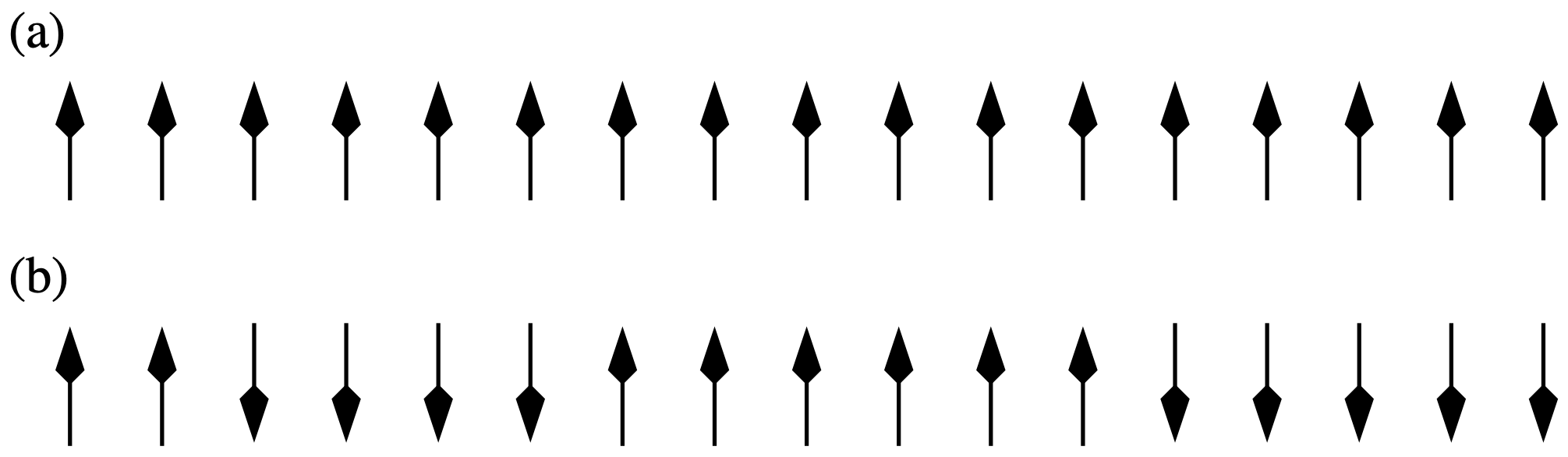
One might well ask why the 2D Ising model is the simplest model to exhibit a phase transition. What about the one-dimensional Ising model (ie. spins on a line)? In fact in one dimension, the Ising model can be solved exactly. It turns out that the system is paramagnetic for all \(T>0\), so there is no phase transition at any finite temperature. To see this, consider the ground state of the system in zero external field. This will have all spins aligned the same way (say up), and hence be ferromagnetic. Now consider a configuration with a various “domain walls” dividing spin up and spin down regions:
Figure 4.2: (a) Schematic of an Ising chain at \(T=0\). (b) At a small finite temperature the chain is split into domains of spins ordered in the same direction. Domains are separated by notional domain “walls”, which cost energy \(\Delta=2J\). Periodic boundary conditions are assumed.
Instead of considering the underlying spin configurations, we shall describe the system in terms of the statistics of its domain walls. The energy cost of a wall is \(\Delta = 2J\), independent of position. Domain walls can occupy the bonds of the lattice, of which there are \(N-1\). Moreover, the walls are noninteracting, except that you cannot have two of them on the same bond. (Check through these ideas if you are unsure.)
In this representation, the partition function involves a count over all possible domain wall arrangements. Since the domain walls are non interacting (eg it doesn’t cost energy for one to move along the chain) they can be treated as independent. Independent contributions to the partition function simply multiply. So we can calculate \(Z\) by considering the partition function associated with a single domain wall being present or absent on some given bond, and then simply raise to the power of the number of bonds:
\[Z=Z_1^{N-1}\]
where
\[Z_1=e^{\beta J} + e^{\beta (J-\Delta)}=e^{\beta J}(1+e^{-\beta\Delta})\] is the domain wall partition function for a single bond and represent the sum over the two possible states: domain wall absent or present. Then the free energy per bond of the system is
The first term on the RHS is simply the energy per spin of the ferromagnetic (ordered) phase, while the second term arises from the free energy of domain walls. Clearly for any finite temperature (ie. for \(\beta<\infty\)), this second term is finite and negative. Hence the free energy will always be lowered by having a finite concentration of domain walls in the system. Since these domain walls disorder the system, leading to a zero average magnetisation, the 1D system is paramagnetic for all finite temperatures. Exercise: Explain why this argument works only in 1D.
The animation below lets you see qualitatively how the typical number of domain walls varies with temperature. If you’d lke to explore more quantitatively, a python code performing a Monte Carlo simulation is available. You will learn about Monte Carlo simulation in the coursework and in later parts of the course.
Show python code
#Monte Carlo simulation of the 1d Ising chain with periodic bounary conditionsimport numpy as npimport matplotlib.pyplot as pltfrom matplotlib.animation import FuncAnimationfrom matplotlib.widgets import Slider# Number of spinsN =20# Initialize spins (+1 or -1)spins = np.random.choice([-1, 1], size=N)# Initial temperatureT =2.0# Set up figure and axis for the spinsfig, ax = plt.subplots(figsize=(10, 2))plt.subplots_adjust(bottom=0.25) # make room for sliderax.set_xlim(-0.5, N -0.5)ax.set_ylim(-1, 1)ax.axis('off')# Create text objects for each spintexts = []for i inrange(N): arrow ='↑'if spins[i] ==1else'↓' t = ax.text(i, 0, arrow, fontsize=24, ha='center', va='center') texts.append(t)def update(frame):"""Perform Metropolis updates over all spins, then refresh display."""global spins, Tfor _ inrange(N): i = np.random.randint(N) left = spins[(i -1) % N] right = spins[(i +1) % N] deltaE =2* spins[i] * (left + right)# Metropolis criterion ensures configurations appear with the correct Boltzmann probabilityif deltaE <0or np.random.rand() < np.exp(-deltaE / T): spins[i] *=-1# Update arrows on screenfor idx, t inenumerate(texts): t.set_text('↑'if spins[idx] ==1else'↓')return texts# Create the animation with caching disabled and blit turned offani = FuncAnimation( fig, update, interval=200, blit=False, cache_frame_data=False)# Add a temperature sliderax_T = plt.axes([0.2, 0.1, 0.6, 0.03], facecolor='lightgray')slider_T = Slider(ax_T, 'Temperature T', 0.1, 5.0, valinit=T)def on_T_change(val):"""Callback to update T when the slider changes."""global T T = valslider_T.on_changed(on_T_change)# Show the plot (ani is kept in scope so it won't be deleted)plt.show()